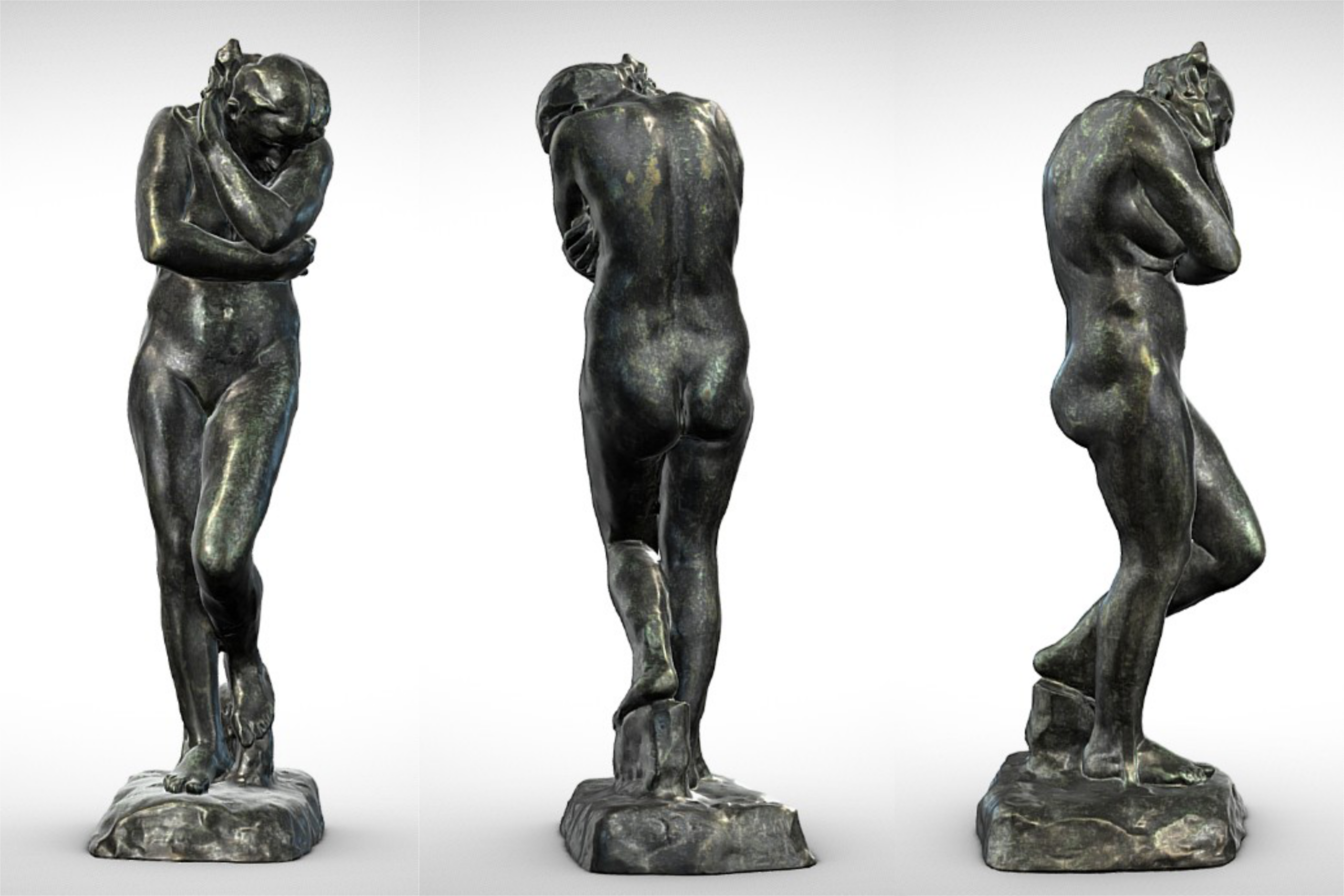
She is alone, lost, desperate. Curled up in her pitiful nakedness, her arms desperately seek to hide her misery; they express a distant memory of a mother’s embrace, of a peace irretrievably lost. She shields herself from a gaze that comes from above, which haunts her soul deeply. Her face is contorted with despair, disfigured by remorse, with that unbearable rage because she allowed herself to be deceived by the accursed voice of the original Liar; she knows well that she is the only one to be blamed… She staggers, tries to walk, to move forward despite everything – for her vital force has not been extinguished – but is this a life for the Living One? The existence ahead of her: a time that will relentlessly bring forth more misfortunes, the never ending childbirth pains, the imminent death of her beloved child Abel, the deception of the one (Adam) who now rules over her, the furious disappointment of that accursed lust that binds her to him. A wretched existence, a gradual descent into nothingness…
In the chapel of the Museum of Fine Arts in Lyon stands a famous bronze sculpture by Auguste Rodin, entitled Eve. Several reproductions of this very work are scattered across the globe, testifying to its success; but what does it say to today’s visitor?
A Puzzling Statue
Let us take a closer look at this astonishing work: is there a single woman in the world who would agree to be depicted with so many, shocking flaws? As we scan the statue from bottom to top, we discover, in turn, splayed toes forming a rather inelegant foot, then legs whose flesh appears damaged, such is the lack of polish on the bronze surface – one might even imagine the presence of varicose veins… Moving round to the back of Eve, we discover a somewhat withered bottom, even though the character’s age would not suggest such ageing; moreover, the hips, contrary to French aesthetic tradition, are decidedly unimpressive. Worse still: the left arm is depicted with overly developed musculature, which would be more appropriate for a male figure. The breasts are unattractive, one hidden and the other distorted by the twisting of the arms, whilst the face is strikingly lacking in delicacy; the nose is deliberately crooked, and the hair is unkempt, with a few fingers of the left hand mingling amongst the strands. A hand, incidentally, whose completeness is doubtful…
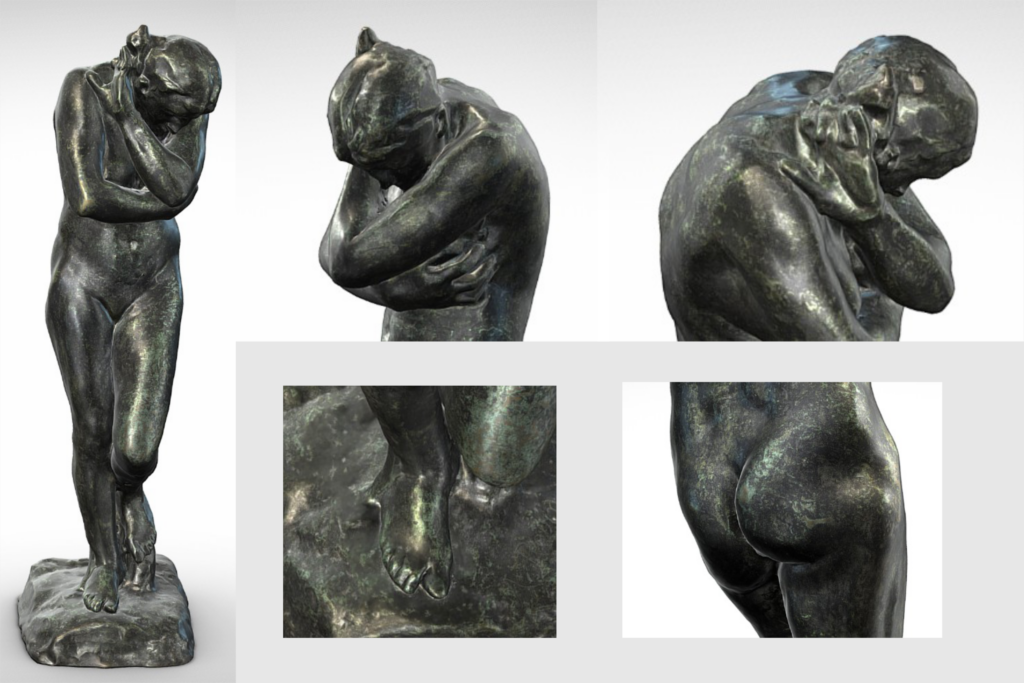
Every detail of this figure conveys a deformity intended by the artist. Let us step back to view the work as a whole and try to grasp its movement. One is even more struck by its instability: from the front, she appears to be leaning slightly to the right, as if on the verge of falling; the position of her legs suggests a hesitant forward movement, like a step she wishes to take but cannot, or a pose that is anything but static. The overall twisting of the body conveys a sense of flight, emphasised by the position of the left palm—the only part of the body turned upwards—yet turned upwards to shield herself, as if to ward off a terrible lightning that might suddenly strike.. . The right hand, meanwhile, clings nervously to the ribs and conveys the figure’s complete withdrawal into itself. The German poet Rilke describes her in this manner:
The head sinks deep into the darkness of the arms, which are drawn across the chest as if the person were cold. Her back is rounded, her nape almost horizontal, her posture inclined as if she were listening intently to her own body, where an unfamiliar future is beginning to stir. And it is as though the weight of this future were bearing down on the woman’s senses, pulling her downwards, away from her distracted life, into the deep and humble servitude of motherhood.
Rainer Maria Rilke2
A doomed woman?
We have therefore a very strong initial impression: in the midst of misfortune and anguish, Eve must keep walking even though the path seems insurmountable; she strives to remain standing in order to carry on living, even though part of her would tend to destroy itself. Overwhelmed by the superior force looming over her, she nevertheless resists, and this ultimate resistance gives her a surge of vitality… She is on the brink of despair, and reminds us of the damned figure depicted by Michelangelo in the Last Judgement in the Sistine Chapel:
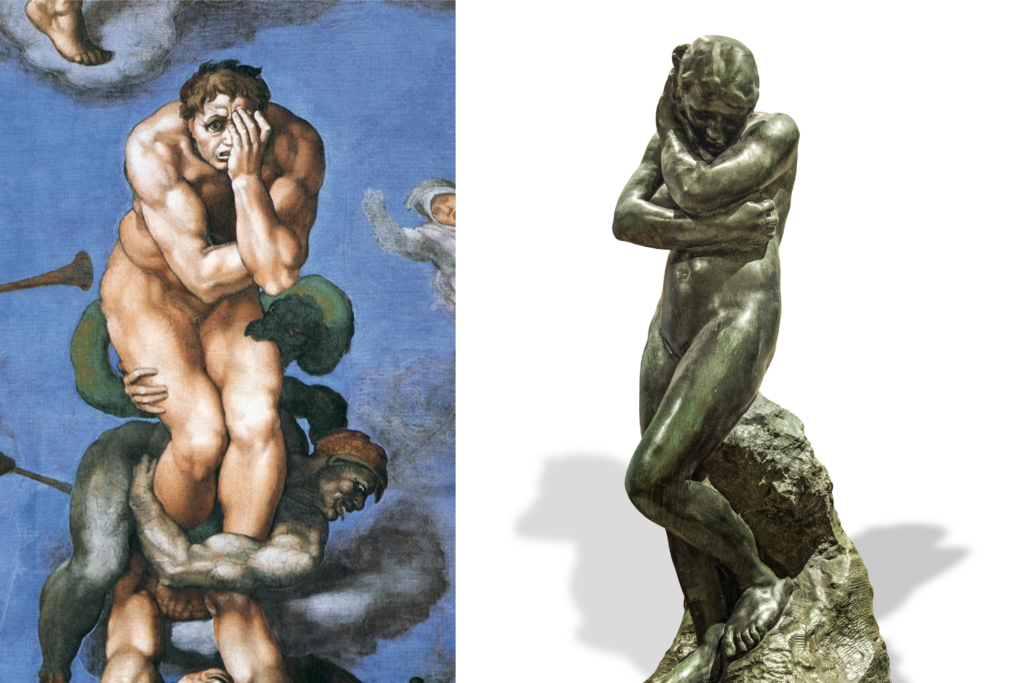
Rodin was a close reader of Dante, and so traces of the Divine Comedy can be found in this Eve: the figure’s crouched posture is reminiscent of the damned in Dante’s Inferno, in particular the character of Francesca, Paolo’s lover – a pair of lovers to whom Rodin dedicated another sculpture. In her grief, she utters these lines, which we might imagine on Eve’s lips:
E quella a me: Nessun maggior dolore
che ricordarsi del tempo felice
ne la miseria; e ciò sa ’l tuo dottore.And she said to me: There is no greater pain than to remember happy times whilst in misery; and your Master knows this.
Dante, Divine Comedy3
Despair: this is a theme that inspired Rodin… And it was above all in women that he found his source of inspiration, for he wrote: ‘I owe everything to women; they walk like masterpieces’4. This is evident in this other bronze sculpture, in which a woman is curled up in her grief:

Let us therefore try to grasp the sense of movement that Rodin sought to imbue his figure with: Eve is not merely a woman in pain; she is a being who has come from a paradise where suffering was unknown, and who now finds herself in a tragic world where suffering has become daily reality. Although she is staggering, she is still standing, and this posture expresses her moral downfall, her transition from innocence to guilt, with that upturned palm defying divine condemnation. Let us recall how Rodin viewed movement in sculpture:
Movement is the transition from one posture to another. […] You will also recall how, in Dante’s Inferno, a serpent clinging to the body of a damned soul transforms itself into a man whilst the man turns into a reptile. The great poet describes this scene so ingeniously that, in each of these two beings, one can follow the struggle between the two natures as they gradually encroach upon one another and supplant one another. In short, it is a metamorphosis of this kind that the painter or sculptor brings about by setting his figures in motion. He depicts the transition from one pose to another: he shows how imperceptibly the first slips into the second. In his work, one can still discern a part of what was, and one discovers, in part, what is to come.
Auguste Rodin5
This is what Eve expresses: our transition from innocence to guilt, our present situation of being cast out of a lost paradise, and of walking through a valley of tears. Eve is now but a shadow of what she dreams to be, of the purpose for which the Creator brought her into the world; she is ashamed of how she believes to appear in the eyes of others. She senses prying eyes all around her, hounding her: the eyes of her husband-master; the eyes of the Deceiver, laughing behind her back; the eyes of God, who has revealed to her the fall she herself chose…
A stunning beauty
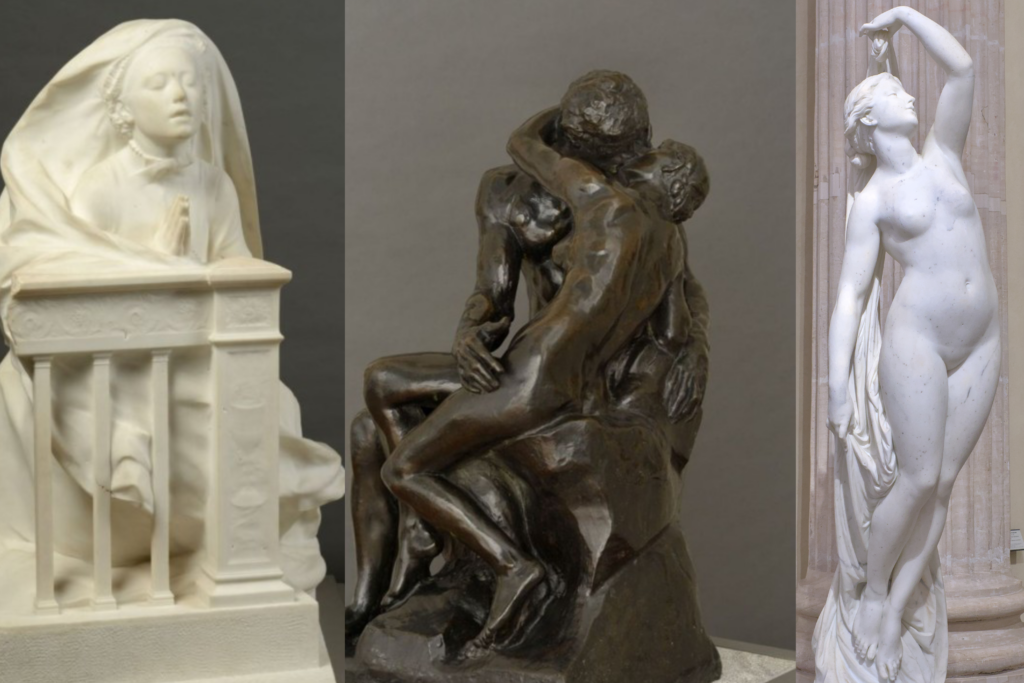
The physical imperfections that Rodin chose to attribute to Eve are all the more striking when one compares her statue with other bronzes he created, such as ‘The Kiss’, a copy of which is in the Musée des Beaux-Arts in Lyon. Here, the perfection of the bodies radiates their beauty to express the very opposite of Eve’s misfortunes: the eternal rapture of love in mutual self-giving.
In the museum’s chapel, the work is also flanked by two statues – created during the same period, at the end of the 19th century – which offer a truly striking contrast, a ‘ chiaroscuro’ not intended by the artists, but suggested by the museum’s layout. On one side, a slender woman with an ideal and perfect figure, ‘L’Aurore’ by Alexandre Schoenewerk; and on the other, a child fervently receiving her First Communion, by René de Saint-Marceaux. They appear all the more beautiful, young and pure as Eve is revealed to be aged, disfigured and distressed.
So then, where does the beauty lie in this work by Rodin? Let us hear what the master himself had to say on the subject:
There is no such thing as a beautiful style, a beautiful design or a beautiful colour: there is only one kind of beauty, that of truth revealed.
Auguste Rodin7
What Rodin sought to embody in this statue is not an expression of the aesthetic canon of feminine beauty, but rather the profound truth of the drama experienced by Eve – by all of us – through the distortion of the rules of that canon, in order to better highlight the tragic aspects of our existence. The ugliness and deformities of the body express the anguish and distress that have haunted humanity since the Fall, a truth dearer to Rodin than aesthetic emotion, or rather a truth that resonates with the drama experienced by his generation of artists, and which also forms part of the ‘splendor veri’ (splendour of the true) that is Beauty. It is a sad truth that our existence is painful; it is therefore beautiful to represent this pain through aesthetic flaws.
This statue of Eve thus expresses the anguish of the century in which Rodin lived—that of the ‘death of God’, which leaves man to himself as he wanders in the midst of night. In it, we find the moral distress described by Baudelaire:
Can we stifle the old, the lingering Remorse,
That lives, quivers and writhes,
And feeds on us like the worm on the dead,
Like the grub on the oak?
Can we stifle implacable Remorse?Charles Baudelaire, Flowers of Evil8
Cursed loneliness
What Eve suffers from, above all, is loneliness. Admittedly, Rodin did design a couple for his Gate of Hell; here is the statue of Adam that was intended to accompany that of Eve, and which is currently on display at the Rodin Museum in Paris:
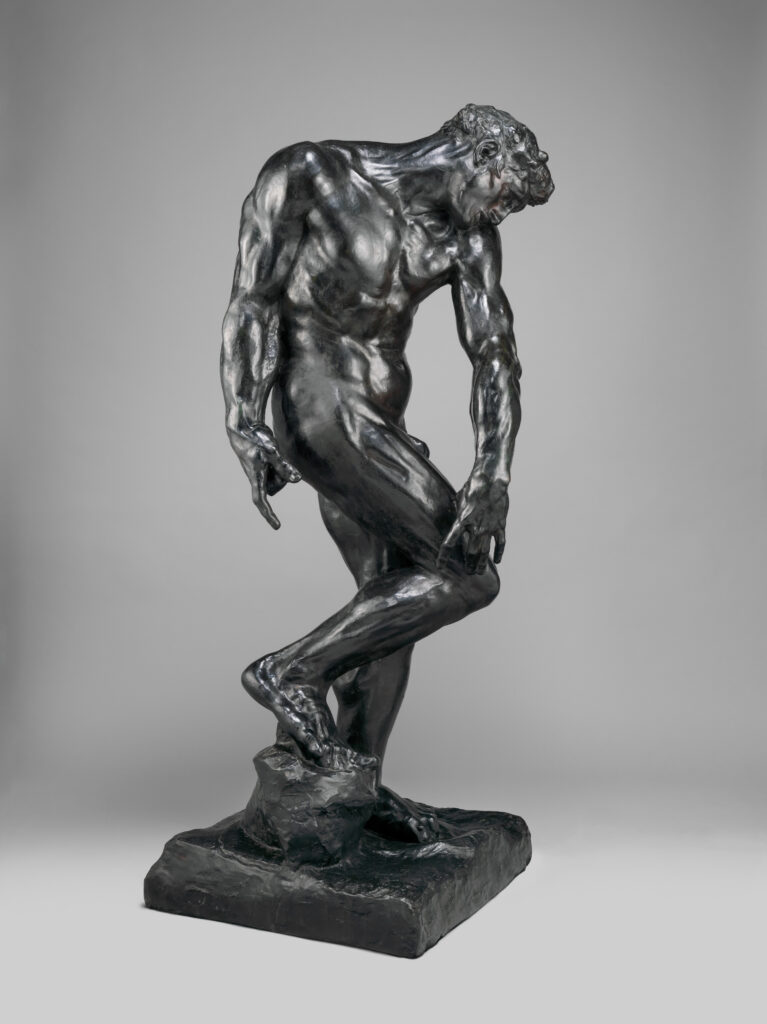
Could this character offer Eve a helping hand? Although he too is trapped in his own downfall, he shows no solidarity or compassion for his companion in misfortune… Rather, the two are conceived as contrasts to one another. Thus, Eve’s isolation – as she ‘finds herself’ all alone in the centre of the choir in the chapel of the Museum of Fine Arts – is not contrived: every gesture of her body reveals such a withdrawal into herself, and such a rejection of the divine presence, that she is irrevocably alone, finding no physical or moral support to hold her back from her downward spiral and headlong rush.
At the Museum of Fine Arts, Eve is placed in the most sacred spot of a disused sanctuary – in technical terms, a desacralised one – where the altar for Catholic worship once stood, serving the devotion of the Sisters of St Peter. Her position in the chapel perfectly expresses the tragedy of humanity cast out of the primordial sanctuary, Eden, where communion with God was so natural that it took place ‘in the cool of the day’ (Genesis 3:8).
Decline and moral oppression
Eve suffers above all from an external oppression that looms over her; her entire, hunched body opens up only through her left hand, which seeks to interpose itself—like a derisory shield—between her body and a superior force that dominates and oppresses her. This is how Rilke describes her: ‘And Eve, as if bent from afar within her arms, her hands turned outwards, as if to push everything away, even her own body as it transforms.’9
But what exactly is this ‘superior force’? If we refer to the biblical text, it would appear to be divine condemnation following the expulsion of Adam and Eve from Eden, due to their disobedience:
To the woman, the LORD said, “I will greatly multiply your pain in childbearing; in pain you shall bring forth children, yet your desire shall be for your husband, and he shall rule over you.” […] Therefore the LORD God sent Adam forth from the garden of Eden, to till the ground from which he was taken. He drove out the man; and at the east of the garden of Eden he placed the cherubim, and a flaming sword which turned every way, to guard the way to the tree of life.
Gn. 3:16.23-24 (RSV)
Why not see in this scene one of our psychological postures as well? Does this protective gesture not express our ‘ego’, which seeks to assert itself in life despite an oppressive ‘superego’? One might think of an external moral standard, conveyed by a certain social order, by education, by social conventions… Our modern literature is full of characters placed in this position: one need only mention Mauriac’s Thérèse Desqueyroux, a new Eve walking alongside us… This moral imposition could crush us with the force of its imperative, against which we pit the full force of our freedom—which prefers to continue along the path, difficult though it may be, rather than submit and thus risk the annihilation of our own individuality… Eve, as she leaves Eden, is like the teenager rebelling against what was imposed upon him during childhood; she would rather suffer freely than obey without truly existing. How derisory is this hand that defies Heaven: it is the meagre psychological defence that an oppressed person can raise against a force greater than himself.
Divine condemnation or moral oppression? We might find within the biblical narrative itself a key to reconciling these two interpretations. The ‘story of the Fall’ (Genesis 3) depicts humanity – Eve – who had not internalised the divine prohibition (‘You must not eat of it…’). She knows of the prohibition concerning the tree of life only through what Adam sought to convey to her, and her dialogue with the serpent shows that she grasps neither its purpose nor its goodness. This is why she is led by the serpent – that is to say, temptation – into harbouring suspicion towards the Creator, who is perceived as a jealous rival (‘you will be like gods…’). The curses we have mentioned are merely the logical consequence of this, like so many external reprimands… Thus, ethics viewed as external norms imposed on the individual becomes monstrous and provokes rebellion: only inner adherence born of conviction enables man to reject evil and choose good.
Eve is thus depicted by Rodin as prostrate in pain, caught between two falls: behind her, the moral downfall that caused her expulsion from Eden, and before her a painful path where she might well stumble and find herself on the ground, crushed by an implacable judgement.
To the Rescue of Eve
This is exactly the same situation experienced by the adulterous woman in the Gospel of John: caught in the act by the Pharisees (moral downfall), she is dragged before Jesus and faces stoning (social downfall and annihilation). Rodin’s ‘Eve’ could well represent this humanity, accused by the self-righteous, trying to survive whilst the terrible accusation rings in her ears:
They said to him, “Teacher, this woman has been caught in the act of adultery. Now in the law Moses commanded us to stone such. What do you say about her?”
John 8:4-5
But if the Creator, in the person of Jesus, has returned to this valley of tears, it is not to pass judgement. Eve has already suffered so much… Now is the time for mercy, and the Master’s voice reaches out to our own moral failings to lift us up:
Jesus looked up and said to her, “Woman, where are they? Has no one condemned you?” She said, “No one, Lord.” And Jesus said, “Neither do I condemn you; go, and do not sin again.”
John 8:10-11
Nicolas Bossu
Si cette explication vous a plu, inscrivez-vous à notre newsletter :
Vous pouvez connaître notre association : c’est par ici !
- @digitus.art (see the digital 3D model) ↩︎
- Rainer Maria Rilke, Auguste Rodin, trad. Maurice Betz, éditions Emile-Paul Frères, Paris 1953, p. 51 (our translation from the French) ↩︎
- Dante, The Divine Comedy, Inferno, Canto V, our translation. This is Francesca speaking to Dante (she is speaking to me) and referring to Virgil (your master). ↩︎
- Auguste Rodin, quoted in Chroniques d’art by Guillaume Apollinaire, Paris 1960, p. 484 (our translation) ↩︎
- Auguste Rodin, L’art, entretiens avec Paul Gsell, Grasset, Paris 1911, pp. 76-77 (our translation) ↩︎
- Credits: for the first two works ©Alain Basset, MBA Lyon; for the third © Romainebehar, Wikimedia Commons ↩︎
- Auguste Rodin, Ibidem, p. 124 ↩︎
- Charles Baudelaire, Poem “The Irreparable“, translation F.P. Sturm, from Baudelaire: His Prose and Poetry, edited by Thomas Robert Smith (New York: Boni and Liveright, 1919) ↩︎
- Rilke, Ibid. p. 143 ↩︎