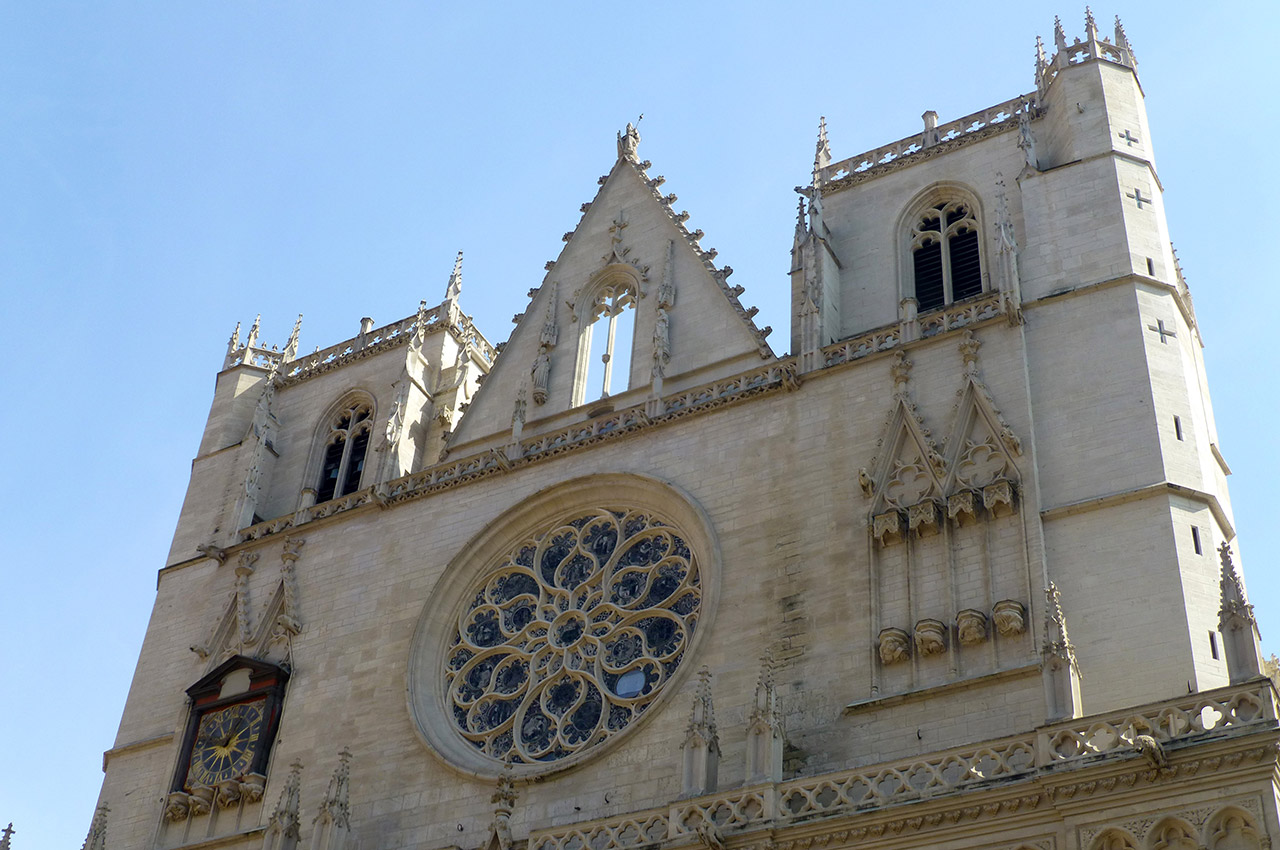
Why do we men look so much at women’s faces? Is it in search of aesthetic emotion? The desire to love and, above all, to be loved? Nostalgia for that first face-to-face encounter with our mother that awakened us to joy? All of these things together, certainly, and much more… Similarly, when we stand before our ancient cathedrals, we cannot stop looking at them. We describe and admire them again and again, as if they were faces where human art, elevated by divine inspiration, allows us to touch the invisible. Let us approach Saint-John Cathedral in Lyon: the features that make up its façade are invitations to wonder.
Well Anchored in the City
Let us begin by acknowledging the obvious: the façade of our cathedral in Lyon, although beautiful and harmonious, does not attain the grandeur of its Gothic sisters such as Chartres or Reims. A quick sketch highlights its strong horizontality: it is structured by two large rectangles, emphasized by the two balustrades and the gallery of kings:
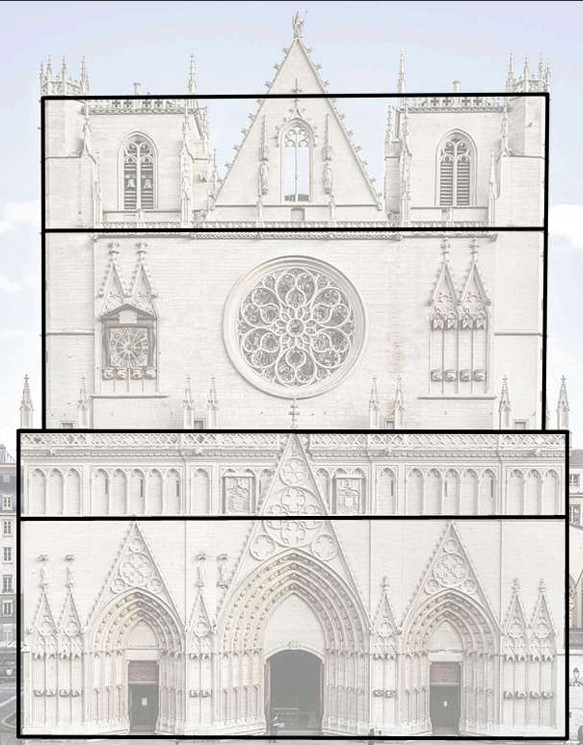
It took several centuries for Bishop Guichard de Pontigny’s project to be fully completed: in 1175, he decided to found a new Romanesque cathedral; it became Gothic as builders worked on it, and the façade was not completed until 1481. I am almost tempted to say that the initial mystical impetus ran out of steam. .. A horizontality that is striking when compared to other cathedrals:
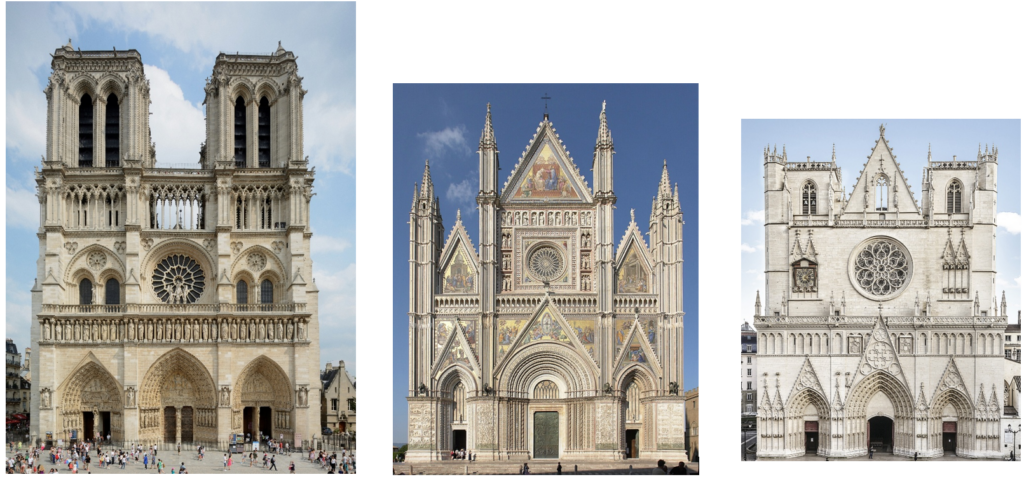
The soaring lines of Notre-Dame in Paris are the result of a unified Gothic project that was completed relatively quickly, in around 75 years, by authorities (royal and episcopal) who were very proud of the new style invented in the Île-de-France region. In Orvieto, we can already see the Gothic style shifting towards greater horizontality, with a façade completed at the end of the 14th century. Was this the beginning of a transition to the Renaissance? The façade of Saint John Cathedral seems to have taken the same path a century later…
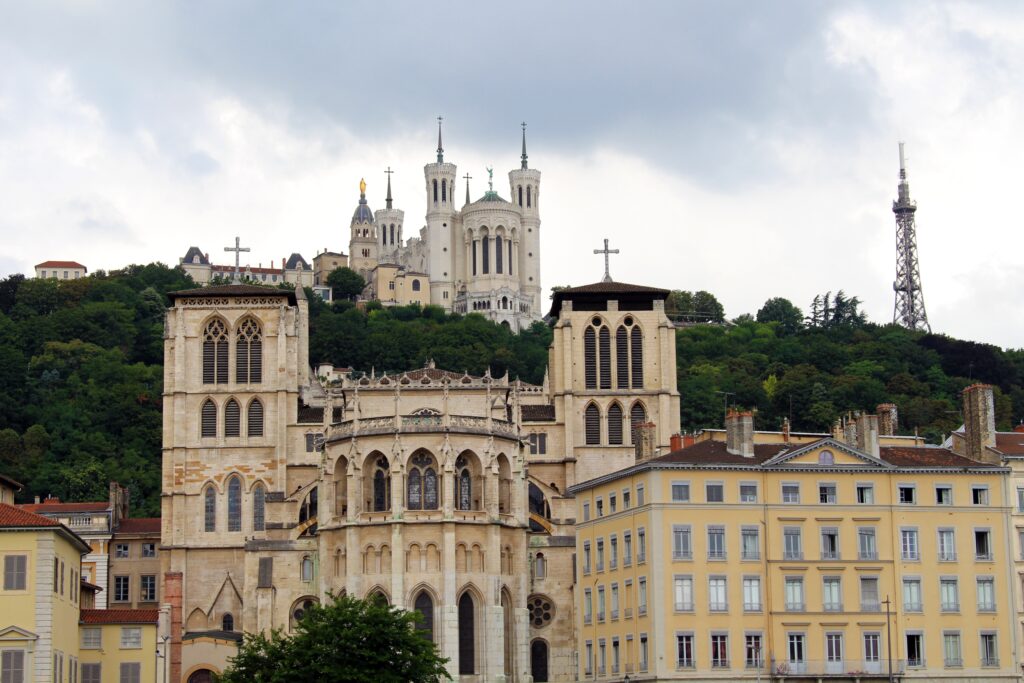
This reminds us that the cathedral is above all the ‘house of God among men’: a dwelling that remains monumental, to show that its Inhabitant is a guest far above all men; but a dwelling that fits into the urban fabric and structures it. It is only in modern times that we have created the large forecourts that isolate cathedrals. In Lyon, this is particularly visible on the other side of the Primatial Church, when admiring its chevet along the Saône:
The cathedral is thus integrated into the life of the city, like a mother surrounded by her children seated around her. It sets the pace for the whole household by marking the time: the clock on the façade goes hand in hand with the bells that announce the hours; it invites us to enter and discover the incomparable astronomical clock inside. It also proudly bears two coats of arms that remind all its children of significant aspects of their shared history, like photographs placed on the living room dresser: the presence of Pope Pius VII and the King of France expresses the city’s dual loyalty, both religious and civil1.
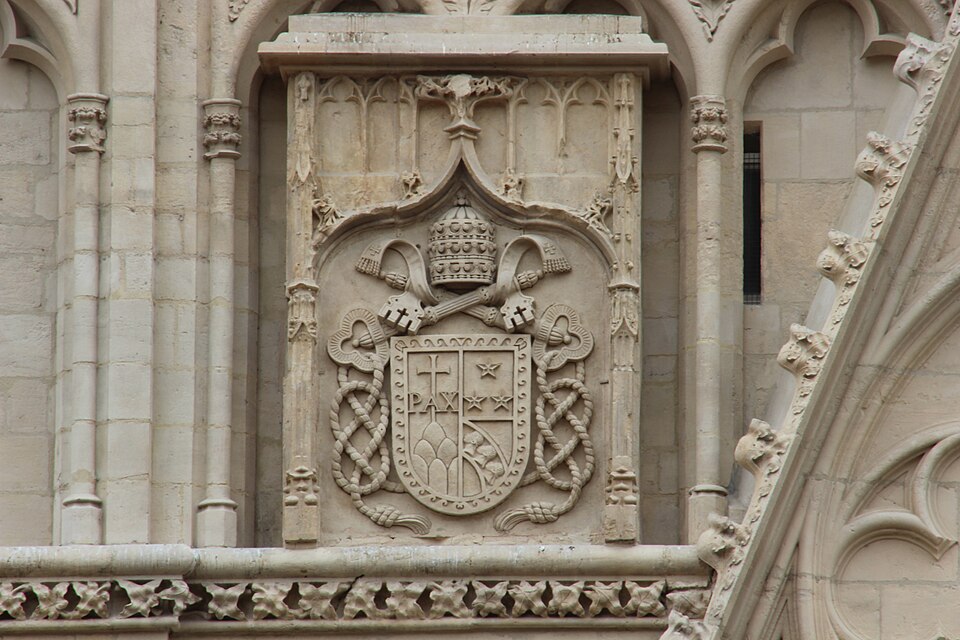
This mother’s face is also damaged by the conflicts that tore her children apart: the ‘gallery of kings’ is empty of its statues; the angels on the arches have been decapitated… These are the sad consequences of the violence of the Wars of Religion and the Protestant occupation of 1562. But this mother continues to instruct her faithful through the fabulous picture book that is the medallions2. In all this, we recognise the cathedral as the house of the Lord among us:
Behold, the dwelling of God is with men. He will dwell with them, and they shall be his people, and God himself will be with them.
(Rev 21:3, RSVCE)
Looking Upwards
Our cathedral is not merely rooted in the social life of the people of Lyon: it shows them Heaven, so that they do not remain attached to the bourgeois concerns of this world, but raise their thoughts to Heaven. Sursum Corda! This second aspect corrects the horizontality, and we have highlighted the elements in this diagram:
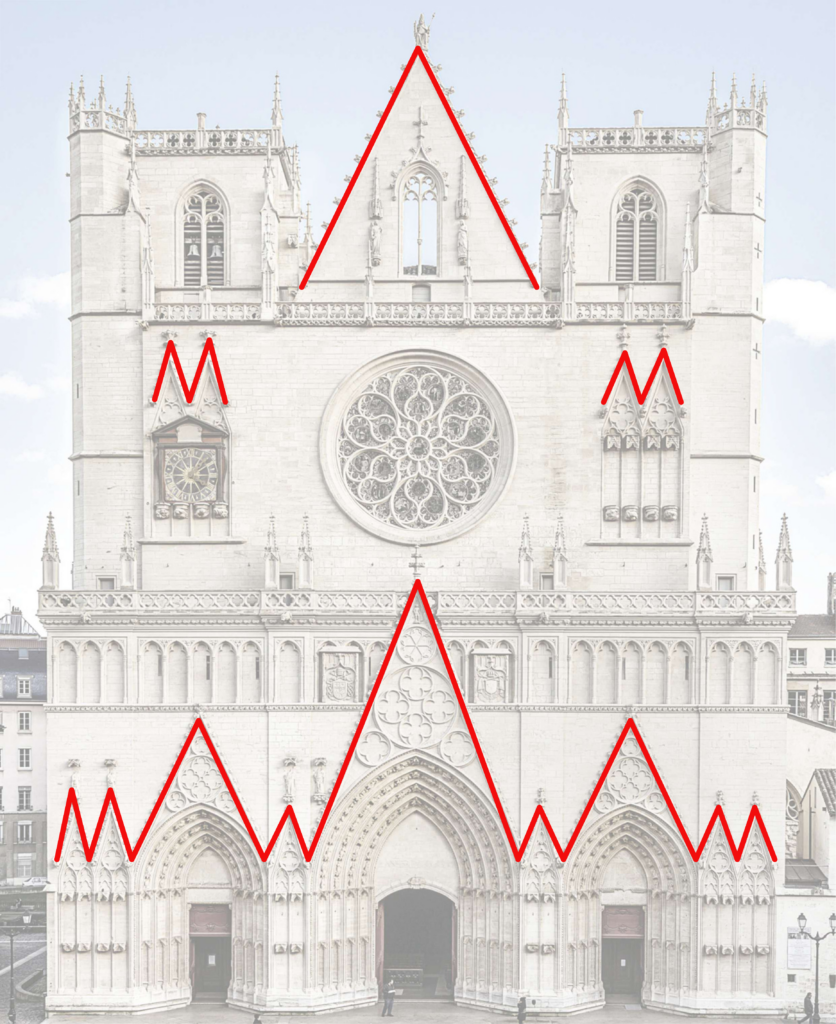
The entrance porches are enhanced by monumental gables: the two side gables, lower than the central one, emphasise its height and invite the eye to follow this vertical direction. Our gaze then begins its ascent towards the sky: like a mountaineer, it takes hold of the multiple pinnacles, which are like signs to continue upwards; it is framed by two towers, quite modest when compared to other cathedrals, which blend into the façade wall. Finally, it rests on the upper pinion, which it discovers with delight and which keeps it in suspense:
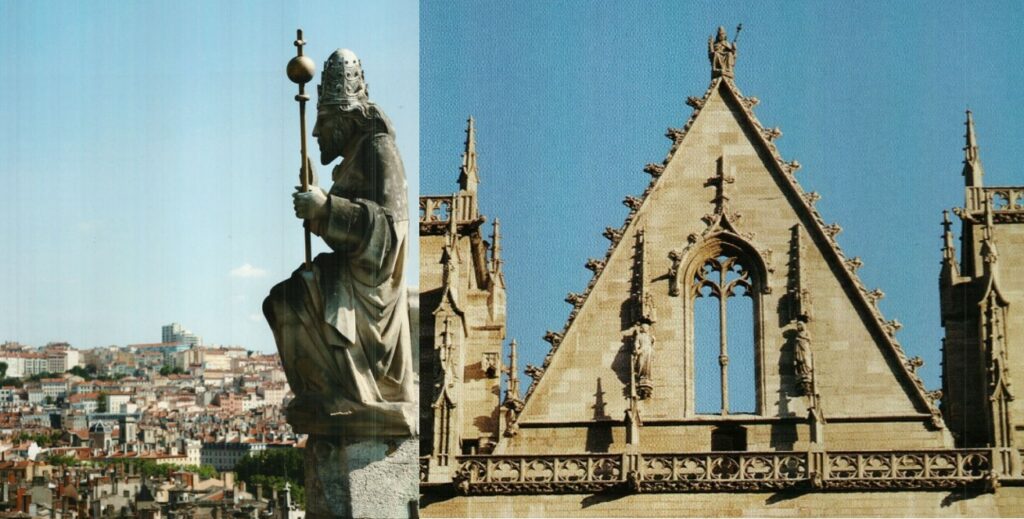
This pinion amazes us with its simplicity: at its base, the angel Gabriel and the Virgin Mary face each other to immortalise the moment when the Eternal One entered into time. At its summit, the Father blesses the city and all humanity with benevolence. This statue, untouched by the violence of the Baron des Adrets, has stood for centuries with all the attributes of power (crosier, crown)3.
In the middle of the pinion, astonishing in its simplicity, is an open bay, delicately adorned with a very slender column: it offers no obstacle to our gaze, revealing the sky directly to us. How better to express the role of ‘window to Heaven’ that the cathedral intends to play? We are reminded of Jesus’ promise to Nathanael:
Truly, truly, I say to you, you will see heaven opened, and the angels of God ascending and descending upon the Son of man.
(Jn 1:51, RSVCE)
The Sky Among Us
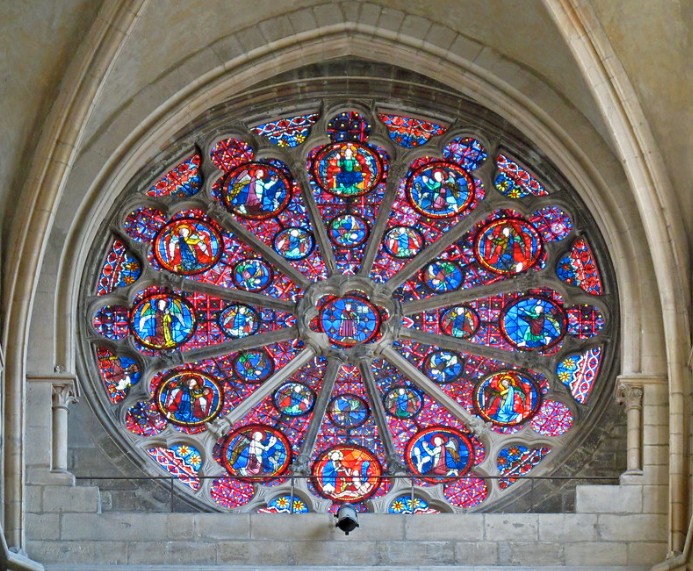
But what would our cathedral be without it rose window? With its flamboyant style, its multiple rays majestically counterbalance the two previous directions, lightening the horizontal in what could have been heavily anchored to the earth, connecting the vertical to our human world.
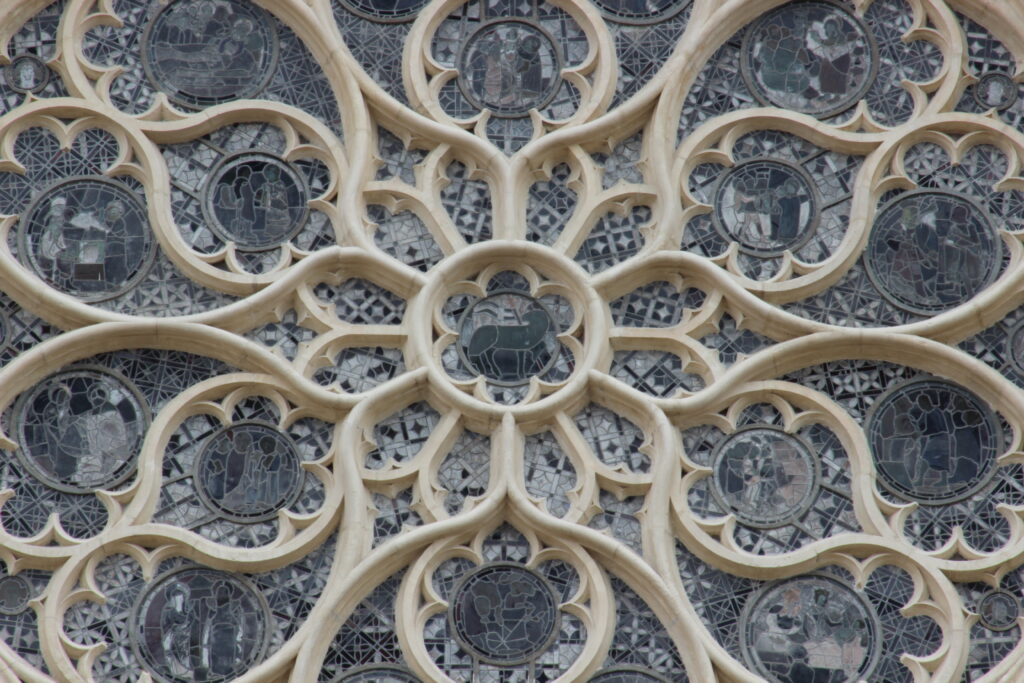
Its multiple rays suggest a fire burning inside, causing the elements to spin wildly… And this fire does exist; it is at the centre of the rose window: it is the Lamb, symbol of Jesus… Angels dance around him, celebrating the mysteries of Christian faith. Let us be captivated by the beauty of this stone lacework, encrusted with colours, to perceive something of the divine liturgy. In Heaven, the angels celebrate the glory of the Lamb:
I heard around the throne and the living creatures and the elders the voice of many angels, numbering myriads of myriads and thousands of thousands, saying with a loud voice, “Worthy is the Lamb who was slain, to receive power and wealth and wisdom and might and honor and glory and blessing!”
(Rev 5:11-12, RSVCE)
The Mystery of God is present among us: that is the meaning of this rose window. While the square, for Christians, is the image of the earthly world with its four directions and, above all, its rough edges, the circle evokes perfection, infinite movement, the end of time; in a word: Heaven. By depicting the mysteries of Redemption in rose windows, the brilliant builders of our cathedrals expressed both the perfection and completion of the work of Salvation, and the ultimate goal to which these mysteries lead us: Heaven.
Thus, the rose window is found at the centre of the façade: this expresses that God (the circle) dwells among us (the rectangle), and that in this stone dwelling we can find the path that leads to Him.
An Invitation to a Spiritual Journey
This beautiful façade extends a double invitation to us, like the smiling face of a woman who is an eternal promise of happiness.
Its wide entrances are designed for processions, and the People of God, to the rhythm of the psalms, join the angels of the arches in singing ‘Hosanna!’. This is the first invitation, to join the guests of the Cathedral in praise.
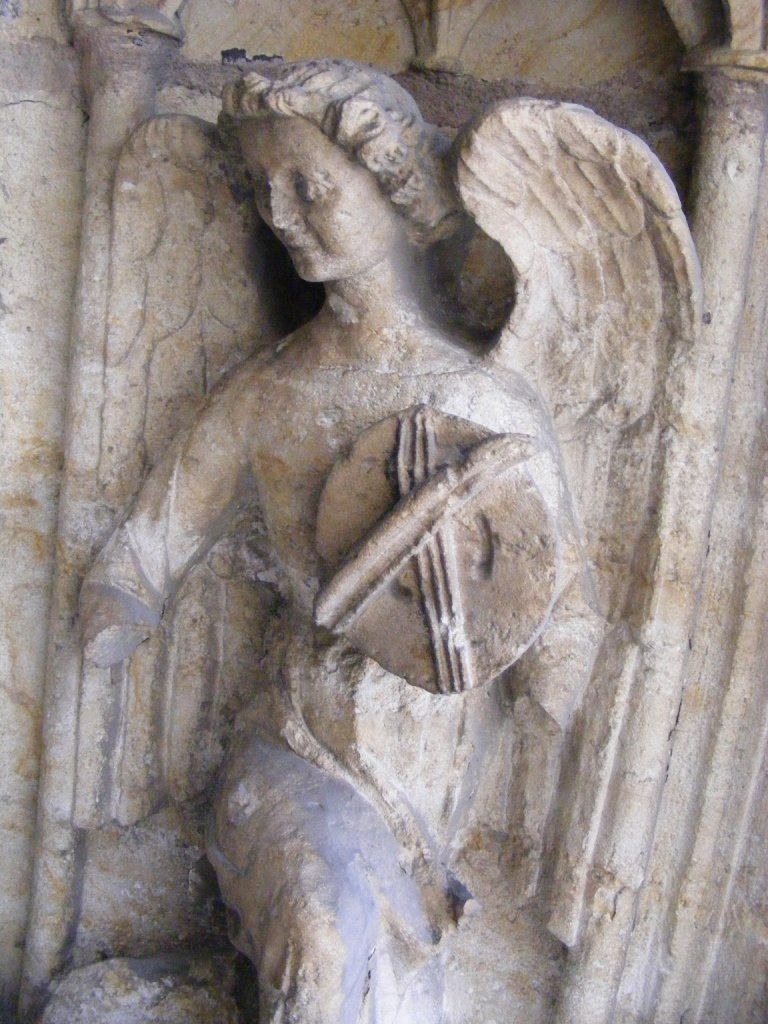
The second invitation comes from the rose window: beyond its ornamental role, it urges us to enter the Cathedral to admire it illuminated by the sun. Inside, mysteries shine forth, the presence of Heaven in our existence; outside, they remain hidden from us.
The maternal face of the Cathedral thus addresses us with these kind words: ‘Come! Enter, take your place, lift up your eyes and let your heart desire Heaven, for it comes to you within my walls!’
Nicolas Bossu
If you liked this article, you might also appreciate our YouTube videos.
- The coat of arms of Pius VII replaced that of Sixtus IV (1471–1484), who reigned when the cathedral was completed and whose coat of arms was destroyed in 1562. ↩︎
- To discover this fascinating world, visit for example this website. ↩︎
- The original statues by Hugonin of Navarre, dating from 1481, were lost and replaced by their 20th-century imitations. ↩︎