One scene in Dostoevsky’s work has remained famous: in the middle of his novel Crime and Punishment, two very unusual characters begin to read the Gospel of John1. They are Sonia, a young girl who has become a prostitute against her will, and Raskolnikov, the murderer whose state of mind the author analyses. Together, they open the Gospel to read the episode of the Resurrection of Lazarus (Jn 11)… What light in such thick darkness! Dostoevsky conveys his conviction to us: it is not healthy souls who are touched by Jesus’ message, but on the contrary those who are so buried in darkness that they yearn with all their being for the light. Simply to survive.
A Rather Frivolous Painter for a Religious Work
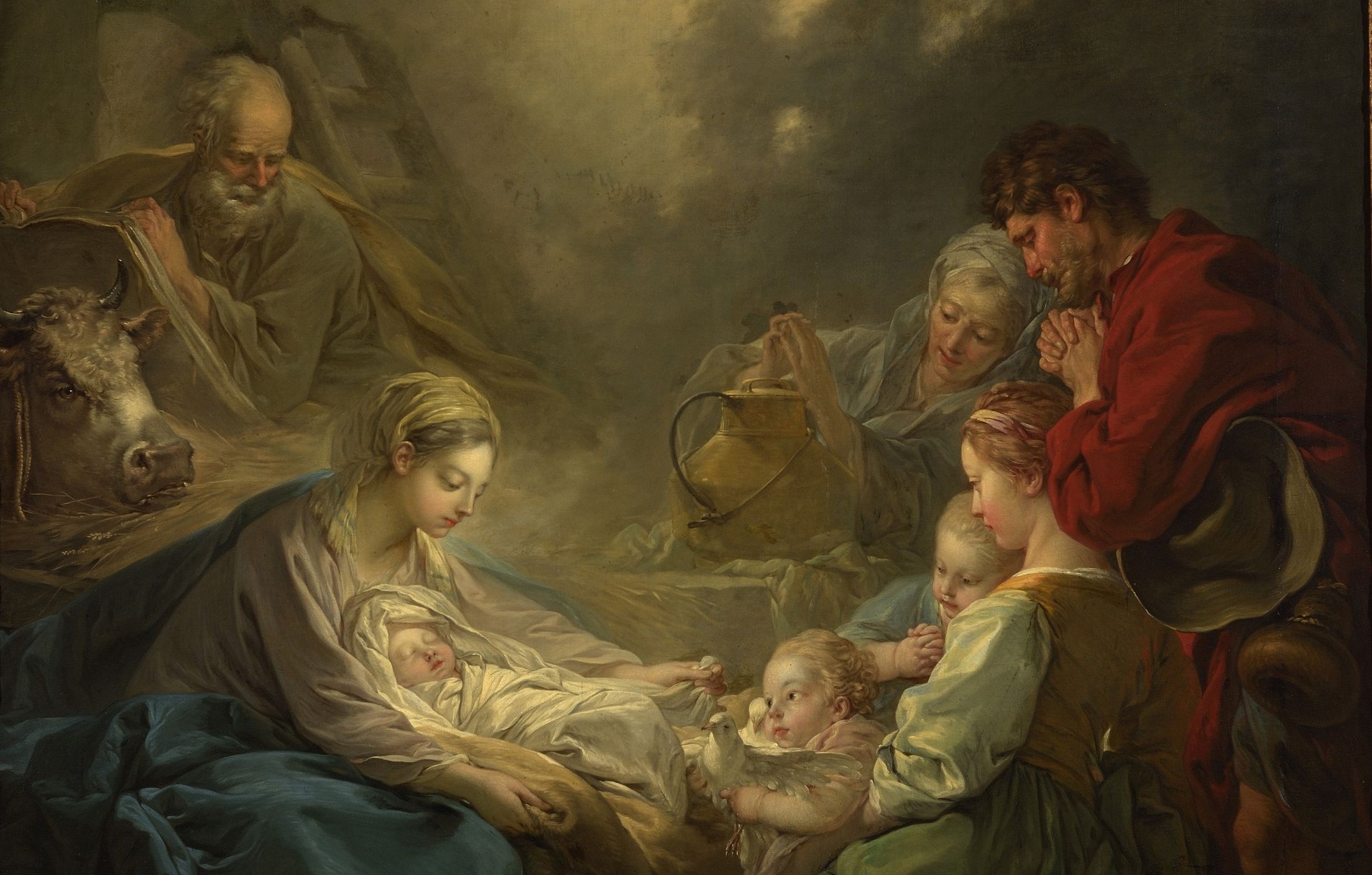
The painting we are interested in today2 immediately conveys a profound religious meaning: we feel radiated by the light that comes from the Child Jesus, and the characters surrounding him draw us into their wonder at such tenderness and simplicity. However, the two people behind this painting are not really religious, and their personal lives do not reflect Christian ideals. They are a bit like Sonia and Raskolnikov, reading the Gospel together… Their names are François Boucher and Madame de Pompadour.
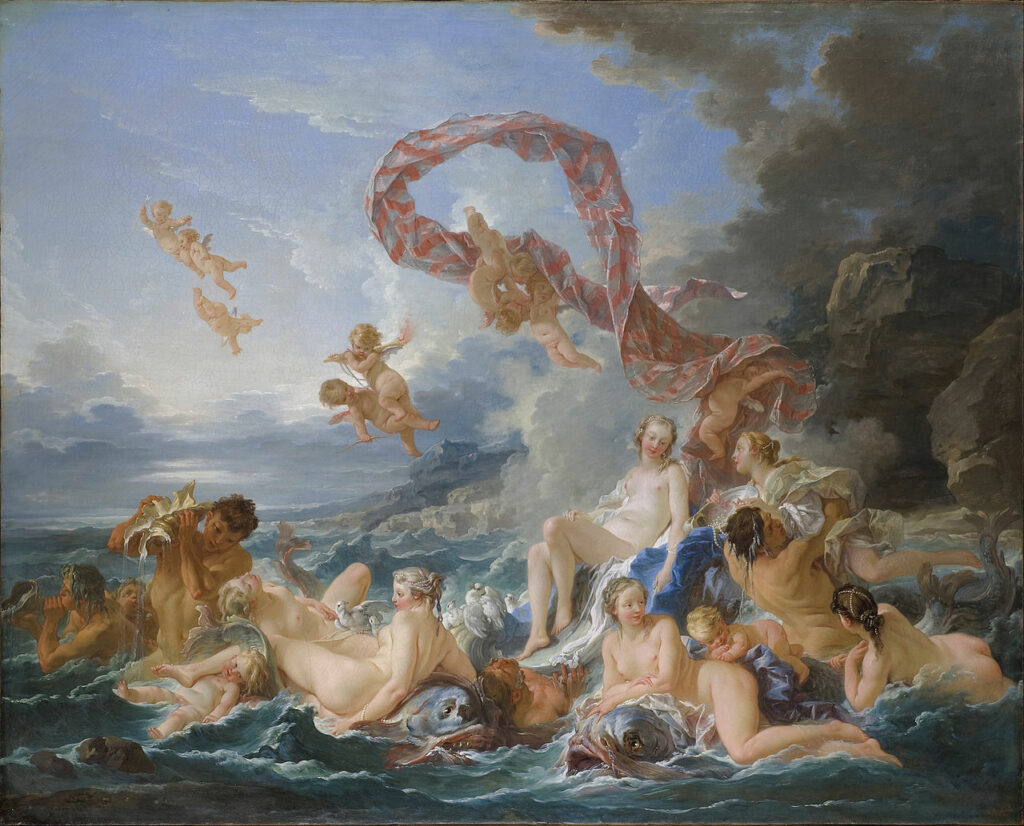
Boucher presented this painting at the Salon in 1750, where it was quite successful, earning him a place in the Louvre and soon after, the position of First Painter to the King. He was better known for the mythological themes of his paintings, with a pronounced taste for the female nude, displaying the frivolity typical of the Regency years. Here, for example, is his Triumph of Venus:
When he presented his painting The Light of the World at the Salon, it was without any title3: a way of showing that he was aware of moving away from the traditional canons of Christian iconography. Indeed, the canvas is neither a Nativity scene – where would the donkey be? – nor an Adoration of the Shepherds, since the figure on the right is a pilgrim, recognizable by his water bottle. The dove carried by a child could allude to the Presentation in the Temple… But Boucher wants to move away from these well-established codes and presents us with a scene of touching simplicity, almost a genre scene: the wonder of a child.
What family has not experienced that enchanted moment when the face of an infant leaves everyone in awe? François Boucher had the genius to capture that moment.
An Unusual Patron
It was the Marquise de Pompadour who commissioned this painting to Boucher for her private chapel in her château at Bellevue, which Louis XV had just given her. She, too, did not really fit in with Christian morality. First of all, she was of bourgeois origin (born Jeanne-Antoinette Poisson), something the royal family would never forgive her for. Secondly, she had already been married before she met the king and became his mistress – even though the Parliament of Paris had officially pronounced her separation from her husband. The Dauphin nicknamed her ‘maman putain’ (whore mum): one can imagine the violence of such a nickname in the world of the court at Versailles.
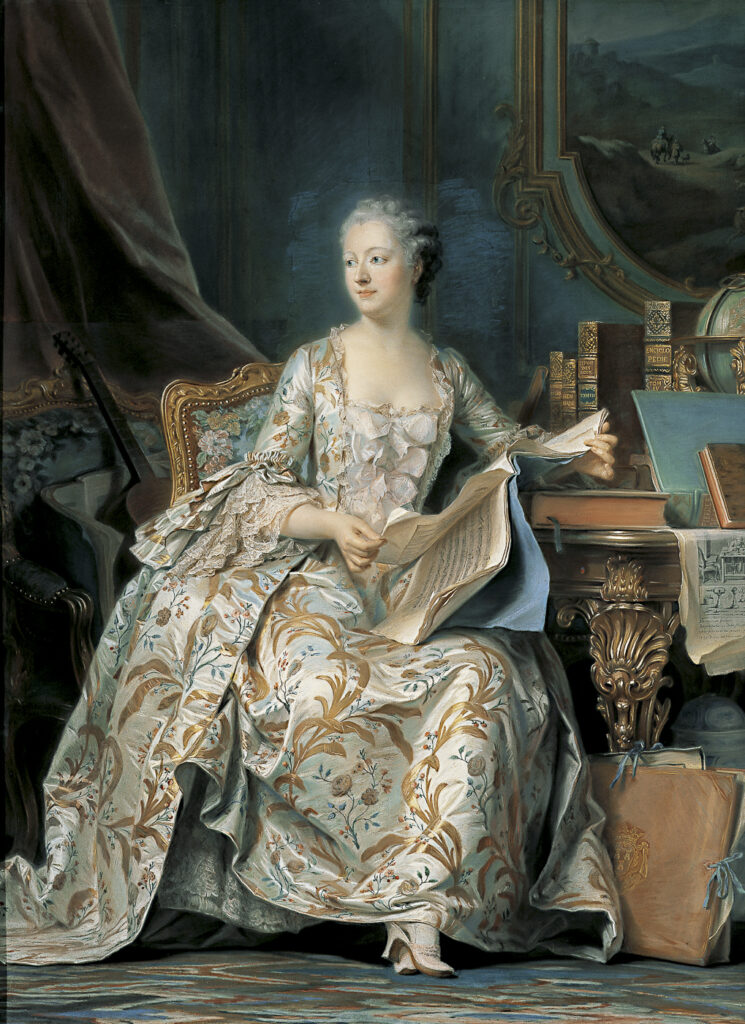
Nevertheless, she became the favourite of Louis XV, who gave her the Petit Trianon and the title of Marquise de Pompadour. Thanks to her excellent education, particularly in the art of conversation, she shone at the royal court and became a patron of the arts; she inspired fashion and left her mark on the second half of the 18th century, giving us the inimitable ‘Pompadour style’. Here is her portrait by her contemporary Maurice-Quentin de la Tour:
A Radiant Light
Pompadour and Boucher were friends: he taught her drawing, she promoted him at court. We can therefore assume that they composed this truly remarkable and innovative painting together, in which so many elements convey a mystery full of tender light.
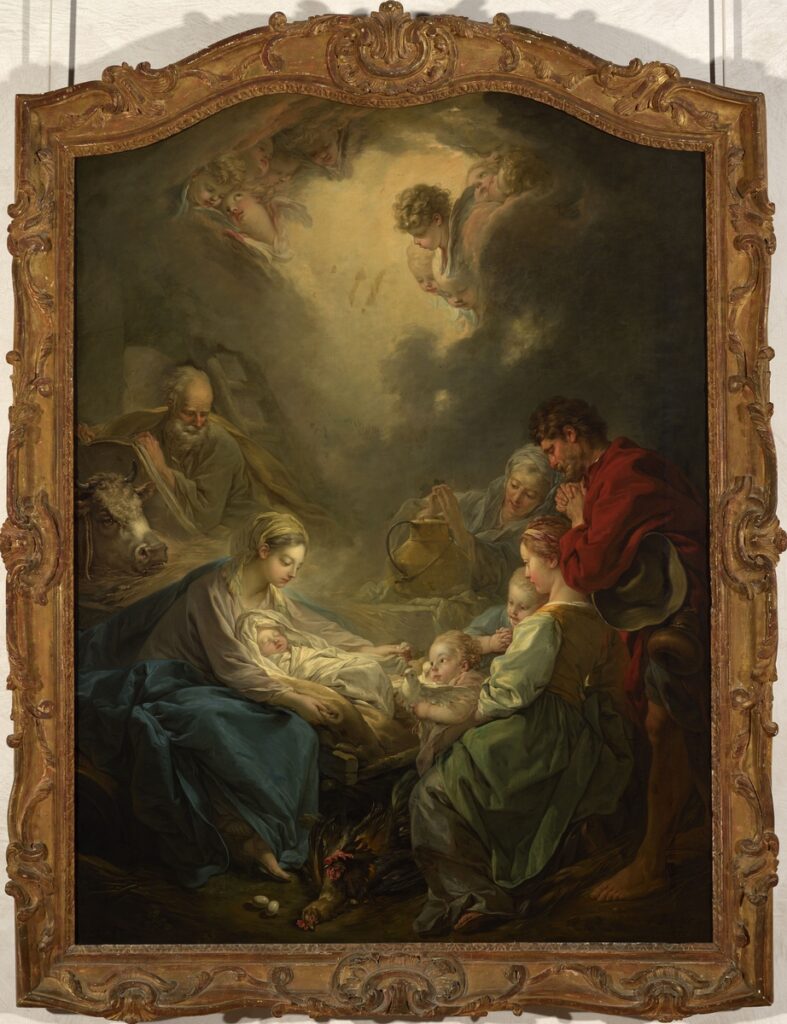
Simply follow the play of light to fully appreciate this masterpiece. It springs from the celestial sphere above: a warm and reassuring light emanating from a Divinity who looks down upon humanity not to watch over it, but to come to its aid. The figures of the little angels express this tenderness, which Saint John notes as follows:
God is light and in him is no darkness at all. (1Jn 1:5)
This ray of light focuses on the Baby Jesus and bounces off Him as if off a convex mirror, illuminating all the figures4 5. They are arranged in an upward curve: there are few straight lines in the composition, and this adds to its softness. Note that Mary’s face accelerates this curve and focuses attention on her child, offering him a cradle of tenderness with her whole body. Her two arms open the baby’s swaddling clothes, as if to offer him to the contemplation of the audience. The figure on the left, with his open book, is slightly withdrawn, noting the scene in a large book resting on the head of an ox: one might think of the figure of Saint Luke, the evangelist who tells us about the Nativity and who is traditionally associated with this animal. Everyone seems to be holding their breath and gratefully receiving the warm light that comes from God through the Child.
That is why we have chosen, in the video, to offer a few verses from the evangelist John, in his Prologue (Jn 1) and in his First Letter (1 Jn 1), which introduce us to the mystery of the Word who is the light of men:
That which was from the beginning, which we have heard, which we have seen with our eyes, which we have looked upon and touched with our hands… is the word of life. (1Jn 1:1)
The word was the true light that enlightens every man was coming into the world. (Jn 1:9)
In him was life, and the life was the light of men. The light shines in the darkness, and the darkness has not overcome it. (Jn 1:4-5)
A Meditation to Find Consolation
Let us observe the four female figures facing Jesus and his mother. They are arranged according to the different stages of life: a small child (holding a dove), an older child (standing back), a teenager (in profile), and a mature woman (with her hands joined in prayer). This is certainly no coincidence. The painting was positioned in Madame de Pompadour’s private oratory and appeared when she opened the panels for her private devotions; she herself must have stood in front of the scene, almost at the same height as the other figures. She therefore fitted naturally into the group of women, especially as she was 28 years old at the time of the composition: the age of an adult woman but not yet elderly, the one missing from the succession of four figures. It is also the age at which the Virgin Mary, whom she faces, is depicted.
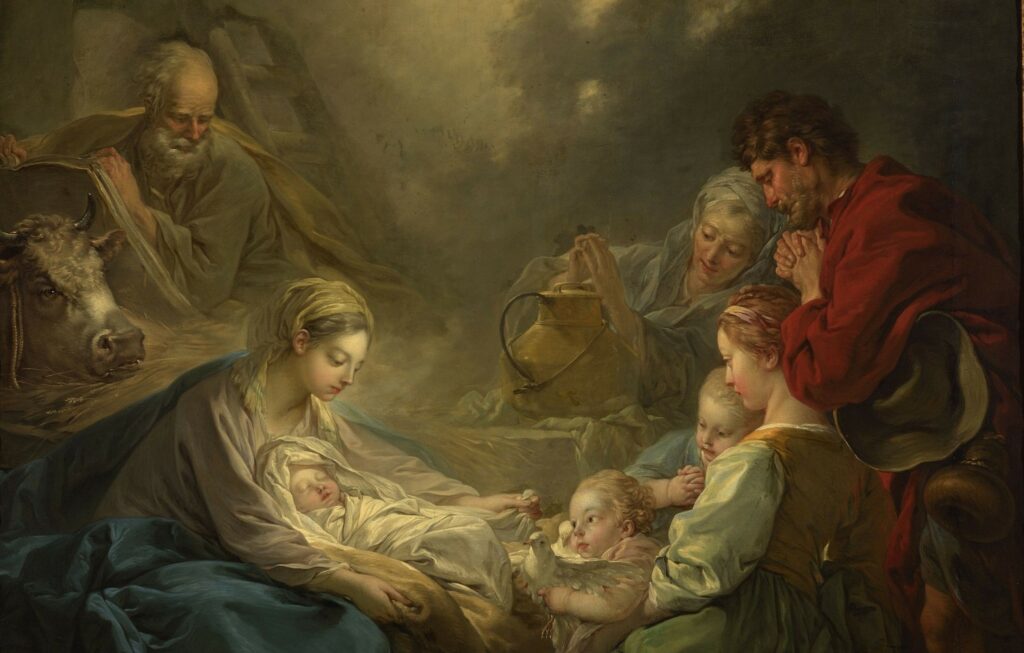
We can therefore assume that Boucher and Pompadour wanted to depict a scene of vanity: a meditation on the fleeting nature of life and the inexorable passage of time. This is all the more likely given that the marquise’s health was very fragile: constantly ill, she died of pulmonary congestion at the age of just 42. And we know that from 1750 onwards, King Louis XV no longer lavished intimate favours on her, turning instead to younger partners. The marquise knew how precarious her situation was, and how fleeting beauty is. Standing in front of the painting, she retained her nostalgia for the child she was no longer, and felt herself declining towards the old age she dreaded.
But it is also a scene of consolation: while her life at Versailles is fraught with pitfalls; while her health is failing; while she is deprived of the simple joys of family life… she finds in the Child Jesus a consolation and warmth that comfort her. The entire painting expresses this tenderness for a Child who does not judge her, who allows himself to be touched and contemplated by all men, even – and especially – sinners; a child who wants to offer her a little niche of intimacy and gentleness in a ruthless and vain world. The masks of Versailles fall before the simplicity of the Child.
This is what the Light of the world means to her. It took a frivolous painter and a controversial courtesan to receive this consolation from Jesus. Like Raskolnikov and Sonia, they read the Gospel from the misery and hardships of their lives… In the darkness of our earthly journey, it is possible to perceive the light.
Nicolas Bossu
If you liked this article, you might also appreciate our YouTube videos.
- Dostoïevski, Crime and Punishment, Part IV, Chapter 4. ↩︎
- Boucher François (1703–1770), The Light of the World, oil on canvas, 1750, 175 x 130 cm, Lyon, Museum of Fine Arts (Inv. 1955-106 and M.N.R.: 823), courtesy of the Museum for the reproduction of the photograph by Mr. Alain Basset. ↩︎
- The traditional title ‘The Light of the World’ was given to the painting by Etienne Fessard when he made an engraving of it in 1764, allowing a wider audience to become familiar with it. ↩︎
- Here we see the influence of Correggio: Boucher may have seen his Adoration of the Shepherds (c. 1530) in Rome, which has the same structure and use of light as Boucher’s painting, two centuries earlier. See this work here. ↩︎
- Here we see the influence of Correggio: Boucher may have seen his Adoration of the Shepherds (c. 1530) in Rome, which has the same structure and use of light as Boucher’s painting, two centuries earlier. See this work here. ↩︎
