
The first page of the whole Scripture features the clarity of a crystal-clear spring: God creates the world with extreme simplicity, through his all-powerful Word that punctuates the six days of creation. Let us open the sacred text and contemplate how light appears as the very first work of the divine craftsman:
In the beginning God created the heavens and the earth. The earth was without form and void, and darkness was upon the face of the deep; and the Spirit of God was moving over the face of the waters. And God said, “Let there be light”; and there was light. And God saw that the light was good; and God separated the light from the darkness. God called the light Day, and the darkness he called Night. And there was evening and there was morning, one day.
Gn 1:1-5 (RSV)
The Mosaic and the Piano as Servants of Scripture
Two works of art wonderfully illustrate these first verses, which we have used in the video.
First, a musical work: Johann Sebastian Bach’s first Prelude in C Major1. For the great Russian pianist Maria Yudina, this Prelude embodies a primitive truth: its simplicity is not naive, but reveals the very essence of musical language. We approached Bach as a source that irrigates all Western music, in order to listen to his testimony of faith that he left us through his art. As Robert Schumann witnessed:
Sebastian Bach’s Wohltemperierte Klavier is my grammar and, moreover, the best. The fugues in their order I have analysed down to the smallest details; this is of great use and, as it were, of morally strengthening effect on one’s whole being, for Bach was a man – out and out; within him nothing is half done, morbid, everything is written as if for eternity.
Robert Schumann, Letter to Johann Gottfried Kuntzsch2
In this Prelude, the musical phrase rises with extreme simplicity, evoking infinity, and seems to emerge from silence to sing Life. Bach places it at the beginning of his 48 Preludes and Fugues, using the key of C major to form a magnificent gateway to his entire masterful cycle, “The Well Tempered Clavier”, the bible for pianists3. Similarly, the book of Genesis opens with the page of Creation, where the divine Word emerges form silence to create in the very simplicity of God, and this page inaugurates the entire Holy Scripture as a sacred Prelude.
Next, a pictorial work: Monreale Cathedral in Sicily offers us extraordinary 13th-century mosaics illustrating many Christian mysteries. They cover more than 6,000 m² and form a complete cycle illustrating Christian mysteries, drawn from the Old and New Testaments. They draw on the iconographic tradition of the East, which translates into images what believers see through faith. The golden background transports us into the divine world, like a stage set for sacred actors. On the upper register of the central nave, the artist depicted the very beginning of Creation:
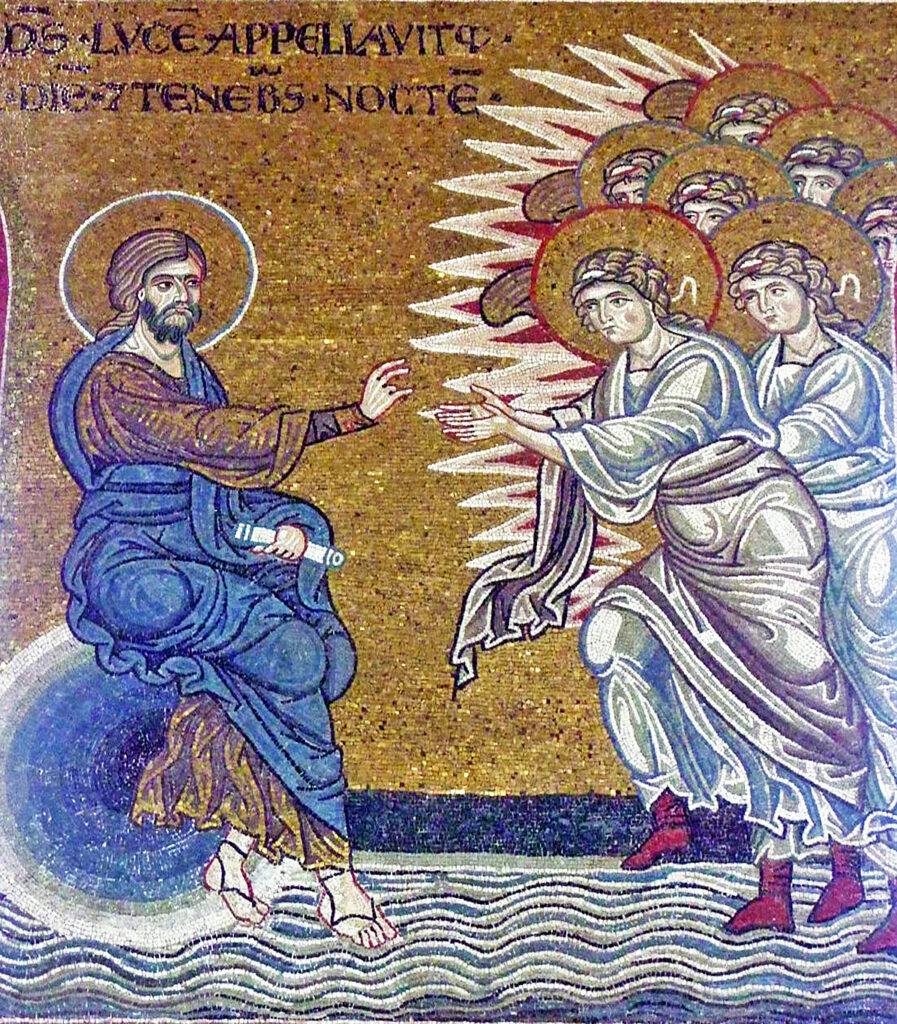
Jesus, Creator?
This image raises several theological questions. Why is God depicted in the human form of Christ? Doesn’t the Creed attribute Creation to the Father? I believe in God, the Father almighty, Creator of heaven and earth…
Theologians teach us that the work of Creation is common to the three Persons of the Trinity: it is the triune God who creates, and not one of the Persons separately from the others4. The Father, the Son and the Holy Spirit create together the world. Moreover, God is not visible, because He is a pure Spirit… How could then an artist represent Him? For Christians, Christ is the perfect image of the Father: therefore, through his humanity we can know God with perfection. This is what the Hymn in the Letter to the Colossians sings:
Christ is the image of the invisible God, the first-born of all creation; for in him all things were created, in heaven and on earth, visible and invisible, whether thrones or dominions or principalities or authorities—all things were created through him and for him.
Col 1:15-16 (RSV)
A Sovereign Gesture
Christ performs a very significant gesture: while holding a scroll in his left hand, as a sign of his power over history5, he raises his right hand toward the angles. It means both a blessing and a speech. A blessing, because God imprints his own goodness on his work and looks upon it with satisfaction6. To express this, the artist used the gesture of the priestly blessing of his time: the right hand raised with the thumb joined to the middle finger, tracing a sign of the cross on the faithful.
But it is above all the gesture of “speaking” (adlocutio), quite common in ancient statuary, as in this famous representation of Emperor Augustus:

In the Book of Genesis, God speaks and creates the world, with a gesture of great authority, since He creates everything by the simple means of His Word. He needs nothing other than this Word, which expresses His will, to separate the elements, create from nothing, assign each creature its place in the universe, shape living beings, and give humans their own vocation. It is therefore not surprising that the artist depicted Christ in the manner of an emperor: note in the mosaic the antique-style drapery and his seated position, signs of authority.
Light and Angels
Another surprise in the mosaic: according to the text, light was created on the first day… yet angels are depicted! Indeed, ancient christian theology was deeply rooted in Platonism, and this first moment of creation was understood as the apparition of the intelligible world, the spiritual world where angels dwell in the light of divine Intelligence. This is what St. Augustine expresses:
Under the name of light, the holy city was signified, composed of holy angels and blessed spirits, as the Apostle says: “For ye are all the children of the light, and the children of the day; we are not of the night, nor of darkness.” […] we understand that the angels were created when that first light was made, and that a separation was made between the holy and the unclean angels, when, as is said, “God divided the light from the darkness; and God called the light Day, and the darkness He called Night.”
St. Augustine, The City of God7
Facing Christ, the angels are in a very significant posture: their hands open as if to receive a gift, their gaze deeply humble out of respect, but also confident in Christ’s goodness. They witness the filial piety that animates believers before the Lord. Their “physical” proximity seems to mitigate the absolute transcendence of the ineffable God: the Christian God has been close to us since the dawn of Creation.
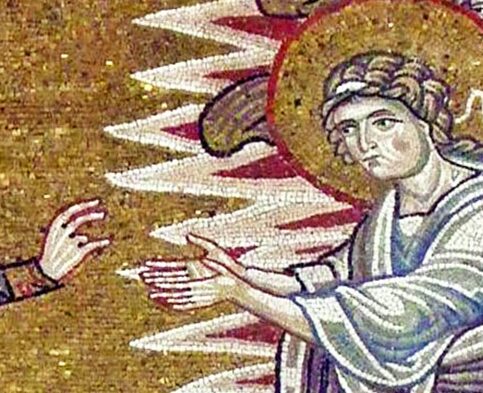
Their whole bodies, leaning toward the Sovereign in a sign of veneration, but also in procession toward Him, express that primordial joy which consists in receiving life and offering it in return. This is the whole meaning of the liturgy, so important in the eastern world that inspires the mosaic.
We are thus challenged to the core of our being: these works show us the most fundamental origin of our existence, that divine simplicity where, in silence, God utters his creative Word. He whispers our name with love and blesses us with his outstretched hand. The angels show us the way to lovingly receive the gift, through a life in procession back to the Creator. They invite us to extend our hands every day to beg from the Lord for the joy and fulfillment that we so sorely lack on this earth.
Our ears hear the Word, but it is our eyes that must open to the Light: unlike the angels, we do not see God… And that is why He Himself comes to join us in the humanity of Christ. We are like the blind man on the side of the road, at the exit of Jericho, to whom the divine Word addresses itself in an extraordinary dialog:
Jesus asked him: “What do you want me to do for you?” He said, “Lord, let me receive my sight.” And Jesus said to him, “Receive your sight; your faith has made you well.” And immediately he received his sight and followed him, glorifying God; and all the people, when they saw it, gave praise to God.
Lc 18:41-43 (RSV)
Nicolas Bossu
If you liked this article, you might also appreciate our YouTube videos.
- The Well-Tempered Clavier, Book I, Prelude in C Major, BWV 846. ↩︎
- Robert Schumann, Letter to Johann Gottfried Kuntzsch, Leipzig, July 27th 1832, quoted in Niecks, Robert Schumann, London: Dent, 1925, p. 110. ↩︎
- Many piano composers have adopted the structure of the 24 Preludes and Fugues (Books I and II), such as Frédéric Chopin (24 Preludes), Alexander Scriabin (24 Preludes), and Dmitri Shostakovich (24 Preludes and Fugues). ↩︎
- As St. Thomas Aquinas teaches: “Creatio non est propria alicui personae, sed communis toti Trinitati.”, translation: “Creation is not proper to any [divine] person, but is common to the whole Trinity.” (St. Thomas Aquinas, Summa Theologica, Prima Pars (I), question 45, article 6, corpus). ↩︎
- See in the Book of Revelation: “And they sang a new song, saying, “Worthy art thou to take the scroll and to open its seals, for thou wast slain and by thy blood didst ransom men for God from every tribe and tongue and people and nation, and hast made them a kingdom and priests to our God, and they shall reign on earth…” (Rev 5:9-10) ↩︎
- “And God saw that it was good… And God blessed them” (Gn 1:21-22) ↩︎
- Book XI, Chapters VII and XIX (Nicene and Post-Nicene Fathers: Series I, Volume II, Philip Schaff et al.) ↩︎